
numpy.random.RandomState.normal#
method
- random.RandomState.normal(loc=0.0, scale=1.0, size=None)#
从正态(高斯)分布中抽取随机样本.
正态分布的概率密度函数,最早由棣莫弗推导,200年后由高斯和拉普拉斯分别独立推导 [2],由于其特征形状,通常被称为钟形曲线(请参见下面的示例).
正态分布在自然界中经常出现.例如,它描述了受大量微小,随机扰动影响的样本的常见分布,每个扰动都有其自己独特的分布 [2] .
- 参数:
- locfloat 或 float 的类数组
分布的均值("中心").
- scalefloat 或 float 的类数组
分布的标准差(差值或"宽度").必须是非负数.
- sizeint 或 int 元组,可选
输出形状.如果给定的形状是例如
(m, n, k),则抽取m * n * k个样本.如果 size 为None(默认),则如果loc和scale都是标量,则返回单个值.否则,将抽取np.broadcast(loc, scale).size个样本.
- 返回:
- outndarray 或标量
从参数化正态分布中抽取的样本.
参见
scipy.stats.norm概率密度函数,分布或累积密度函数等.
random.Generator.normal新代码应该使用它.
注释
高斯分布的概率密度是
\[p(x) = \frac{1}{\sqrt{ 2 \pi \sigma^2 }} e^{ - \frac{ (x - \mu)^2 } {2 \sigma^2} },\]其中 \(\mu\) 是均值, \(\sigma\) 是标准差. 标准差的平方, \(\sigma^2\) ,称为方差.
该函数在均值处达到峰值,并且其" spread"随标准差的增加而增加(该函数在 \(x + \sigma\) 和 \(x - \sigma\) [2] 处达到其最大值的0.607倍).这意味着正态分布更有可能返回接近均值的样本,而不是远离均值的样本.
参考文献
[1]维基百科,"正态分布",https://en.wikipedia.org/wiki/Normal_distribution
示例
从分布中抽取样本:
>>> mu, sigma = 0, 0.1 # mean and standard deviation
>>> s = np.random.normal(mu, sigma, 1000)
验证均值和标准差:
>>> abs(mu - np.mean(s))
0.0  # may vary
>>> abs(sigma - np.std(s, ddof=1))
0.0  # may vary
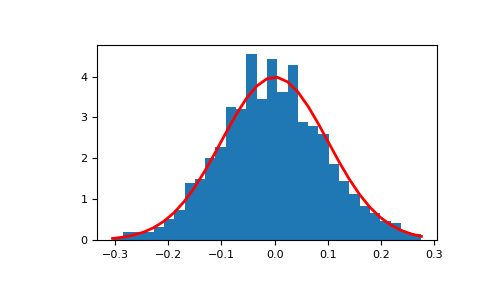
显示样本的直方图,以及概率密度函数:
>>> import matplotlib.pyplot as plt
>>> count, bins, ignored = plt.hist(s, 30, density=True)
>>> plt.plot(bins, 1/(sigma * np.sqrt(2 * np.pi)) *
...                np.exp( - (bins - mu)**2 / (2 * sigma**2) ),
...          linewidth=2, color='r')
>>> plt.show()
从均值为3,标准差为2.5的正态分布中抽取的二乘四数组样本:
>>> np.random.normal(3, 2.5, size=(2, 4))
array([[-4.49401501,  4.00950034, -1.81814867,  7.29718677],   # random
       [ 0.39924804,  4.68456316,  4.99394529,  4.84057254]])  # random