numpy.random.Generator.power#
method
- random.Generator.power(a, size=None)#
从具有正指数 a - 1 的幂分布中抽取 [0, 1] 中的样本.
也称为幂函数分布.
- 参数:
- afloat 或 float 的类数组
分布的参数.必须是非负的.
- sizeint 或 int 元组,可选
输出形状. 如果给定的形状是,例如,
(m, n, k),那么将抽取m * n * k个样本. 如果size是None(默认),如果a是标量,则返回单个值. 否则,抽取np.array(a).size个样本.
- 返回:
- outndarray 或标量
从参数化的幂分布中抽取的样本.
- Raises:
- ValueError
如果 a <= 0.
注释
概率密度函数为
\[P(x; a) = ax^{a-1}, 0 \le x \le 1, a>0.\]幂函数分布只是帕累托分布的倒数.它也可以看作是 Beta 分布的一个特例.
例如,它用于对保险索赔的过度报告进行建模.
参考文献
[1]Christian Kleiber, Samuel Kotz, “Statistical size distributions in economics and actuarial sciences”, Wiley, 2003.
[2]Heckert, N. A. and Filliben, James J. “NIST Handbook 148: Dataplot Reference Manual, Volume 2: Let Subcommands and Library Functions”, National Institute of Standards and Technology Handbook Series, June 2003. https://www.itl.nist.gov/div898/software/dataplot/refman2/auxillar/powpdf.pdf
示例
从分布中抽取样本:
>>> rng = np.random.default_rng()
>>> a = 5. # shape
>>> samples = 1000
>>> s = rng.power(a, samples)
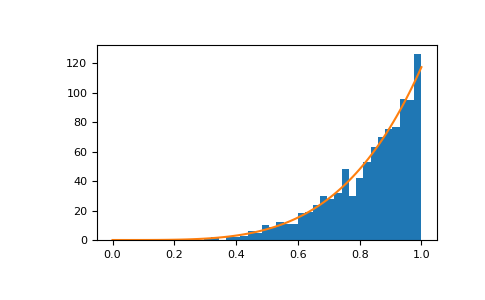
显示样本的直方图,以及概率密度函数:
>>> import matplotlib.pyplot as plt
>>> count, bins, _ = plt.hist(s, bins=30)
>>> x = np.linspace(0, 1, 100)
>>> y = a*x**(a-1.)
>>> normed_y = samples*np.diff(bins)[0]*y
>>> plt.plot(x, normed_y)
>>> plt.show()
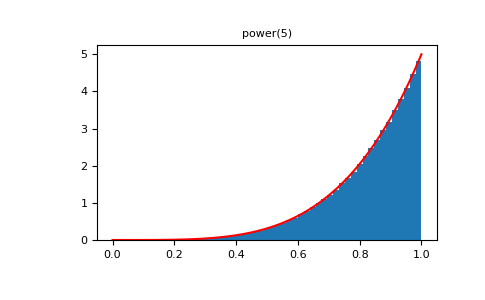
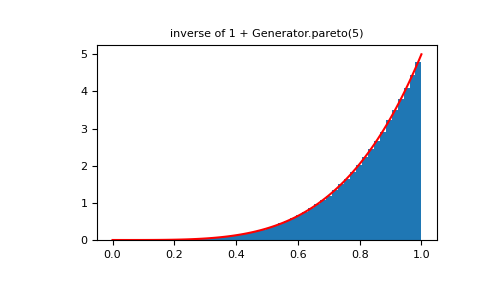
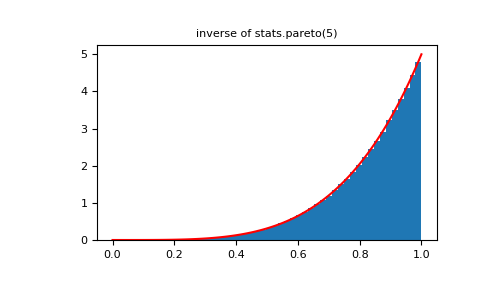
将幂函数分布与帕累托分布的倒数进行比较.
>>> from scipy import stats
>>> rvs = rng.power(5, 1000000)
>>> rvsp = rng.pareto(5, 1000000)
>>> xx = np.linspace(0,1,100)
>>> powpdf = stats.powerlaw.pdf(xx,5)
>>> plt.figure()
>>> plt.hist(rvs, bins=50, density=True)
>>> plt.plot(xx,powpdf,'r-')
>>> plt.title('power(5)')
>>> plt.figure()
>>> plt.hist(1./(1.+rvsp), bins=50, density=True)
>>> plt.plot(xx,powpdf,'r-')
>>> plt.title('inverse of 1 + Generator.pareto(5)')
>>> plt.figure()
>>> plt.hist(1./(1.+rvsp), bins=50, density=True)
>>> plt.plot(xx,powpdf,'r-')
>>> plt.title('inverse of stats.pareto(5)')